
 ES
ES Stroll Through Tarifa’s Historic Center
We invite you to join us for a walk through the historic center of Tarifa so that you can soak up a little history and tradition. We will better understand this historic city by walking through its heart: the historic center; and we will see how yesterday's Rate mixes with today's in a curious harmony.
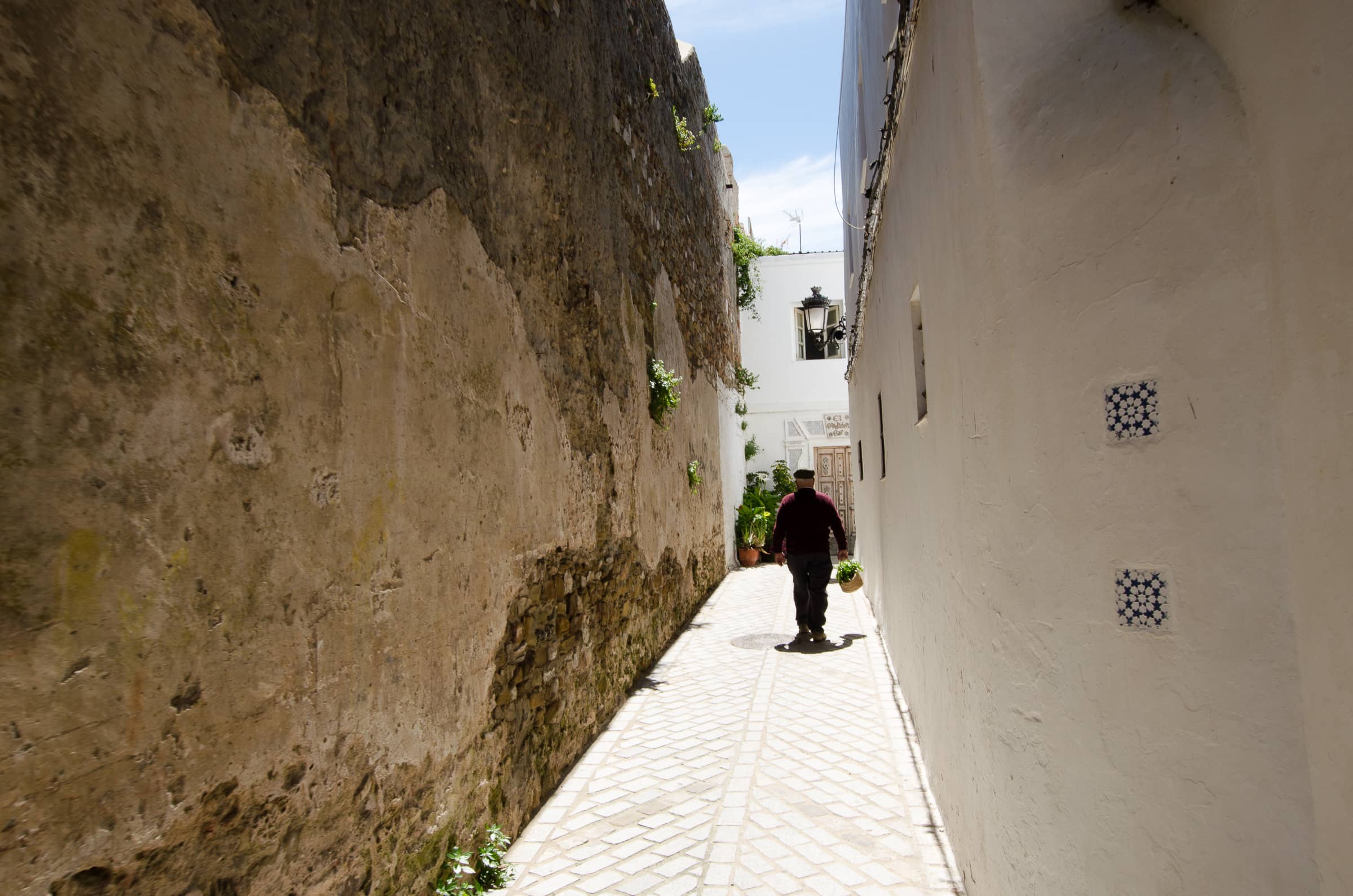 At first glance we are surprised by how well preserved the enclosure and its wall, which dates back to medieval times, are. The old town has stately homes and courtyards, as well as public and religious buildings. Its urban planning is also medieval, with very narrow and irregular streets, sometimes giving the sensation of being inside a labyrinth. We will be surprised by the squares full of life that we will find. We recommend browsing inside the patios. Sometimes the facades of seemingly simple buildings can enclose beautiful patios with many flowers and plants. Another of the curious details that we will find when taking this walk will be the use of tiles in urban signage. They can be seen in the elaborate street name signs, shop signs, house numbering, etc. Searching for them can become a fun game that they can play while they accompany us on this walk.
Our departure point is at the tourist office located on the Alameda promenade, the social heart of Tarifa, with its splendid palm trees, its children playing soccer, the teenagers crowded on a bench eating pipes, the parents strolling the strollers. .. We turn left and enter the old town, crossing the wall through the market arch. We immediately realize the feeling of shelter that the narrow streets and tall buildings give us. Even on sunny or windy days, you are more protected inside the wall. The feeling of protection from the enemy in past times is also appreciated. On the left is the Mercado de Abastos, which has functioned as such since 1928, although it dates back to 1536 as a convent. In it we can find fruit, vegetables, meat and fish from the area. No multinational brands here, just genuine natural products of artisanal and local production. We reach Plaza San Martín along San Julián Street where there are pleasant terraces to eat and rest. We continued along the alley on the opposite side of the square and entered the Plaza de San Hicio, dedicated to the patron saint of Tarifa, a disciple of Santigao Apostol who died in the persecution of Nero. This square is also known as Plaza del Perulero, in memory of D. Juan Fernandez de Riofrio who came from Peru with great wealth and lived in a house in this square. This gentleman of Portuguese origin was named alderman of Tarifa and a relative of the Holy Office of the Inquisition around 1625. The name of the next street along which our walk continues, Calle del Lorito, is due to the fact that El Perulero was brought from the Americas. exotic birds that must have had a special attachment to this street. We arrive at San Francisco Street, a pedestrian street where we can see its traditional bars, as well as a number of bars and establishments, ideal for the Tarifa nightlife.
On the left we find Calzada, Tarifa's main street, also known as Sancho IV street. Until the end of the 19th century, this street was a river that, like in many other ancient cities, was covered and sewered to control contagious diseases. In January 1970, heavy rain caused a huge flood that covered the street with half a meter of water in just a few minutes and left many families homeless. At the end of the road, also known as Calle de Sancho IV El Bravo, we find the Church of San Mateo from the 16th century. Around the church we have interesting buildings. Along Calle del Coronel Moscardó we will see the Casino and further down the old Royal Prison, now converted into an exhibition hall. Continuing with our walk we find ourselves in the Plaza de la Fuente with the first running water fountain installed in Tarifa in 1831. On the left up the street we reach the Plazuela del Viento with a wonderful perspective of the strait and Morocco in the background. From this point Morocco is at a distance of about 14 kilometers, which makes Tarifa the closest European city to the African continent. It is one of the most spectacular landscapes in the world and if the weather conditions are favorable one can spend a good time contemplating the spectacle sitting on one of the benches at the viewpoint located at the top of the wall. To our right we find the Plaza de Santa María where there are several important buildings such as the town hall, the library and the museum among others. In the center of the square there is a curious fountain affectionately known as the fountain of the frogs. Going down the stairs to the other side of the square is Calle Almedina where we will see one of the doors to the old Arab medina (city) of Tarifa. At the end of this stepped street we enter Guzmán el Bueno Street again, we turn left and we find at the back the Castle of Guzmán El Bueno, dating from the year 960. It was always a defensive castle, hence its sober but We recommend a visit for a better understanding of what it must have meant for those brave fighters to live and defend Tarifa. We continue along Calle de la Santísima Trinidad, right in front of the castle gate. It is a long and narrow street where the Baroque and Neoclassical style church of San Francisco is located. At the end of this street we find the market where our walk ends. We hope you enjoyed it.
🚀 Ready for your getaway?
Book directly with us and save on portal commissions.
📱 Book via WhatsApp: +34 645 221 402